Monday, September 26, 2016

Labor Day Weekend 2016


I've lost track already of all the places we've been since we left Dan's office. There are highlights, of course, but the details. The people we've met and talked with almost fade into the colors of the day. Pam has a hand-written notebook with tidbits of information about our daily activities, which helped remind me that we entered Canada on the first. We went through one of those entry points you can imagine that they assign to Border Agents who have trouble kissing the appropriate asses in the appropriate manner. It was only open from 9am to 5pm. 
Pend-d'Oreille River just across the Canadian border


We had spent the night at the Colville Grange Campground. It was free and had a host too. The host had her great-grandson living in her trailer. It seems that her 30-year-old granddaughter was finding it too difficult to raise a child and maintain her lifestyle. This situation is not new, but sad nonetheless. Brennon was a fun, little 4-year-old. He and I played frisbee until meltdown before bedtime. We picked up the game first thing in the morning. Just as we were about to leave Ron struck up a conversation about our van. He and his wife, Kathy, have a trailer but have been looking at getting something simple to operate and travel with. Ron had worked with Fish and Game for 31 years and was glad to have been asked to retire. 

By the time we stopped for the day, we had reached Cranbrook, BC and found a Provincial Park just up the road from the entry into the town (Jimsmith Lake). It seems that as in Mexico, there are a lot of abandoned property development projects left over from the crash. We spent the next morning doing laundry and using their WiFi, emptying tanks and doing errands. It was lunchtime before we got out of there. 


Because of our late start, Waterton Lakes National Park only got a drive through as we were chasing one of the few camping spaces left. There were only a couple of spaces left in one of the campgrounds at the edge of the park. We are finding that the fewer services offered at a camping location the better it suits us. This is probably due to the campsites look more like campsites and less like a parking space at Wal-Mart. 
Approaching Waterton Lake National Park in Canada
Meadow adjacent to the remote campsite in Waterton

 
As we walking up the road from paying the $20CA at the registration booth, I was startled by a car quietly following us. We joked a bit about my reaction as we let him pass by. He just didn't want to startle us. That kind exchange was the introduction to an evening of good company, as Mark was the young man camped in the next site. He was maybe 30, yet had gone through enough relationship heartache and occupational headache by this time to give him a lot to think about. He loved Waterton and had spent a lot of time there since moving to the hinterlands from the big city. The campground was bordered by the Belly River, but unless you realized it was there you wouldn't even know to go looking. Mark led me through the trail hidden by high grasses and bushes to the river not more than 30 meters (this is Canada) from our campsite. He showed me where his girlfriend had watched a family of five beavers played and lived just across the river. When I took Pam down to show her the river, we were graced with a beaver sighting about 2 meters from where we were standing. Man, that was one huge beaver! 
The little knob sticking out of the bank on the right side is the home to a family of beavers

September 2
Breakfast was a simple bowl of cereal and a banana. Mark was trying to entice me with a foil gourmet creation of eggs and sausage and potatoes, but I the call of Glacier was greater. I wanted to get there and get some hiking in. We had been doing too much driving and not enough doing. I did make note of his recipe though with cut up baby potatoes that were cooked with the sausage, then the egg added and the cheese added at the end. 

Road scenery on way to Glacier

One of the best decisions we made so far in this trip was to park the van and take the shuttle to the hiking trails within Glacier like we were required to do in Zion last year. It was free and watching the poor souls who thought that having their own vehicle was so necessary fight for a very limited parking availability proved how valuable it was. 

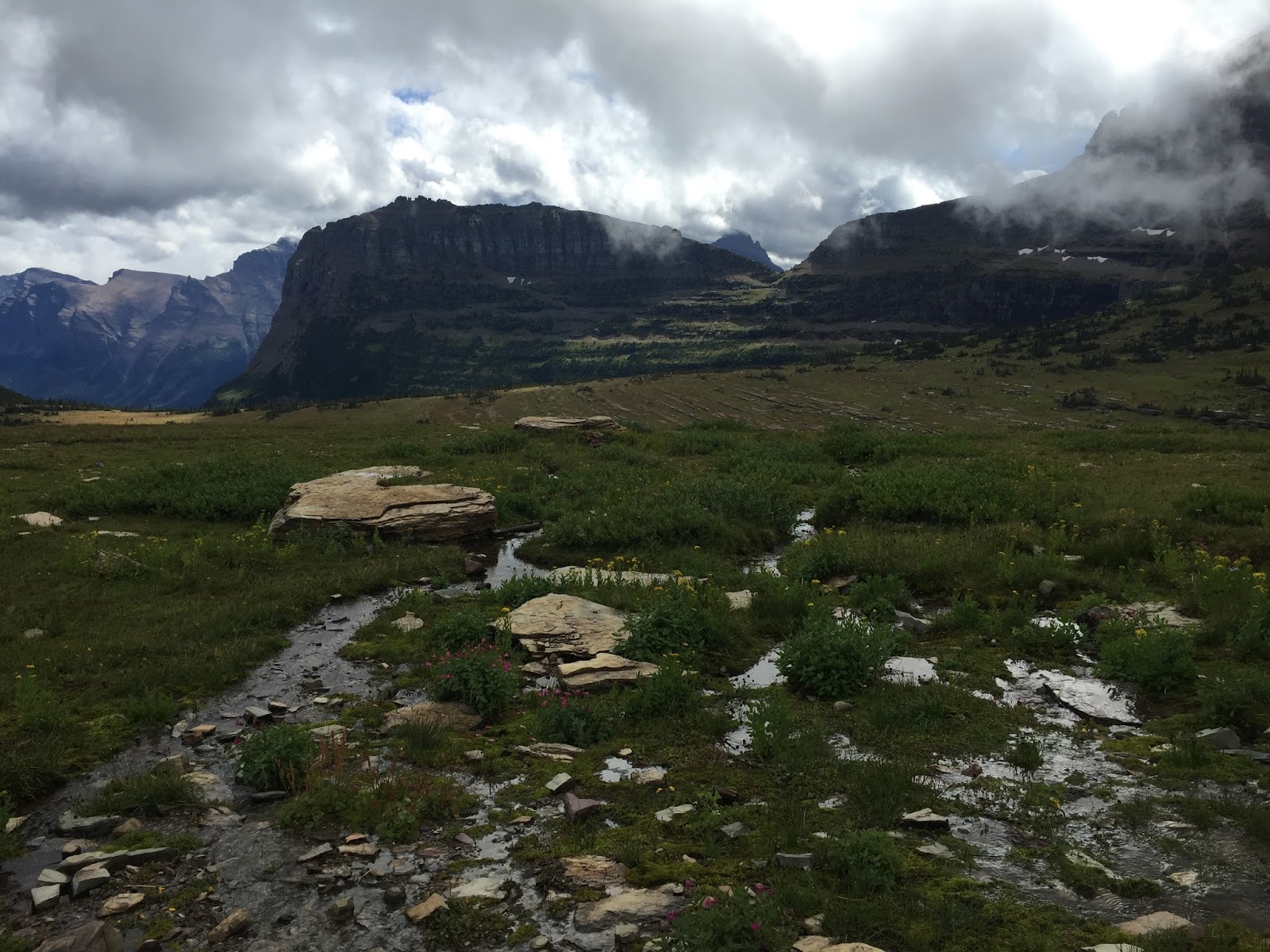
We went directly to Logan Pass, which is the mid-way point on the Going-to-the-Sun Road, to hike the trail to Hidden Lake Overlook. It was a gorgeous trail of boardwalk interspersed with natural features and paved where necessary. It was only 1.7 miles to the Overlook, yet it provided quite a bit of adventure. The wind had nothing to slow it down and it seemed to take advantage of that situation. The clouds were swirling and moving fast changing the light and landscape constantly. We weren't sure, but the four big-horned sheep sure seemed like they were a bit of artistry placed on the hillside for our enjoyment. The lake down in the deep bowl would have been mystical in any light, but the swirling clouds made it scene right out The Hobbit. 


As if on queue, as soon as we turned back towards the visitor's centre (this is Canada), we were treated to a whole spectrum of weather all at once. Rain, sleet, snow, high winds and mixed into a show that left us drenched by the time we got back and got on settle headed down off the pass. True magic.

We figured we done for the day, but when we reached the trail head for St. Mary Falls we made a quick decision to get off the shuttle. I think we were as surprised as the shuttle driver by
the decision. Another decision that proved to be a good one. St. Mary Falls were worthy, but Victoria Falls were pretty awesome. And, we were pretty much dry by the time we got back to the shuttle stop. In the final tally, we had got a good eight miles in on the trials. 


St. Mary's Falls


Back into Canada to try and find a place to crash for the night, we chose Park Lake Provisional Park off the map and headed that direction. Of course, the magic box thought it would be best if we toured some of the local haul roads (gravel) as it was the shortest route to the park. By the time we got there, it was 8- ish PM and the park was a reservation-only park. Plus, it was Labour Day Weekend. Katie, the Information Officer at the Park, confirmed that there were no openings at her park, but told us how to get to a municipal park just down the road a bit. We were not able to find it on the GPS, but she laid out some simple directions on how to get there. We stumbled upon it just as the light was going away for the night. 

The magic box has a different idea of short cuts


The Coalhurst Miners Memorial Campground was one of the best situations we've had in awhile for a paid campground. It only cost $20 and had a decent, clean shower that gave you five minutes of heated bliss and a nice boardered level area to park. And it was quiet with only two other fifth-wheeled trailers parked on the other end. The showers were five minutes for a Luney, which is Canada's $1 coin and was something we didn't have. In my going around to ask for change from the two residents there, I met Vernon. He didn't have any more Canadian money as he was leaving the country tomorrow and had worked to get rid of it. He was headed back to southwest Georgia, where his accent was from, after spending the summer in Alaska where it was cooler. His wife of 51 years missed the trip that they had been talking about for years having passed last just last year. She was just 69. 


I was successful in making change for a fiver with the couple in the next trailer and returned to give one of the Luneys to Vernon so he could take a shower tonight too. He offered up a stay at his farm if we got down that way. I told him that were expected to be down in the area in November sometime. A little later he brought by his address and information. It is a visit I look forward to and I circled his town on our map. 

We were up early and out of there before there were any lights lit in the other trailers, so we missed being able to say good- bye. We had our eye on getting to Moose Jaw and spending the night. For some reason, the underground tours of Chinese Railway workers that the Canadian government were generally using as slaves and later used by Al Capone and his men during the Prohibition Era didn't seem all that interesting after we heard about them from the information folks along the Saskatchewan highway booth, so we set our sights on Moose Mountain Provisional Park. It was a long day of driving. We didn't arrive in the less-than-stellar campground until about 8pm. We couldn't figure out how to pay the fee, so we'll try again tomorrow if they're up before we head out.

Monday, September 5th--Labour Day 
And, there are no details as it's been 21 days since the fifth of September that I finally get around to finishing this post and the details are lost into the swirling mass of memories.

Sunday, September 4, 2016

The Trip Around the USA in an RV--The Beginning


We had spent the night parked behind Dr. Dan's building. I had backed the van up over, so that tail section covered the entire width of the sidewalk. I expected that we'd be up way earlier than most of the people coming to work here and I'd have it moved by then. I was wrong. I was so wrong that I was woken up around 6am by someone who wanted to use the sidewalk letting no one in particular know what she thought about people who "block the whole fucking sidewalk" with their vans. I tried to pretend that she didn't know that we were in the van sleeping. 

We ran errands and cleaned and putzed generally between the time Pam had her 8am massage and mine which was set for 2:15pm. We were ready to go. 

It is always exciting to begin a new quest or journey, but we have been running up to this starting for so long that we were just tired of waiting. So, Monday, the 29th, is our start date. And, by the time Dan got done tuning me up it was going on 4pm. The expected traffic was there in Monroe, but after that it seemed that we had the road pretty much to ourselves. 

We found a nice little campsite in Nason Creek Campground on the edge of Lake Wenatchee. $21 for a parking spot right on the bank of Nason Creek. Now considered a luxury, campgrounds will be something that we try and avoid most of the trip. There isn't room in the budget for too many stays. 

We met Jim and Carol, the campground hosts on our walk to try and find the lake. I've been asking every host we come across on how they like being a host. Jim is going on 80 and looks like he's 65 and he's still smiling. Carol is 5 years younger and looks younger than 65. They've been doing this for 21 years and love the lifestyle. Next month they head for Florida to consider changing their residency there. I think they still have their residency in Ohio where Jim sold his well-drilling business at 57 to his son. The motor home is their only home. 

August 30th
Today was "old home week" for Pam, as we passed through
Leavenworth and Wenatchee. Pam graduated from Leavenworth High School reluctantly. Eager to get out of the school that she didn't fit into, she took community college courses in Wenatchee 20 miles down the road. We dropped by unannounced at the local medical center to see one of her childhood friends who was unfortunately not at work today. Dropping by at work for a quick hello unannounced is much better than dropping in at home in such a fashion. The person you're visiting has an easy out by having to get back to work. At home, how do you kick out such rude intruders? Given the non-existent scheduling of our trip, I suspect that these sorts of missed connections might be more the norm. 
 
Once out of Wenatchee, the landscape opens up into miles upon miles of rolling farmland being prepared for winter crops. The roads are ribbons of asphalt that go off into the distant horizon that is not marred with obstructions. This all changes once we cross the earthen dam that creates Banks Lake. Ancient, worn cliffs cut by the mighty Columbia over the millennia walled in Banks Lake with enough room for a road on one side. We hadn't really gone that far, but we found a access point on Banks Lake about 10 miles south of Steamboat Rock State park to camp free for the night. Tomorrow, we plan to tour the Grand Coulee dam. 
 
August 31st, Wednesday
We got up at our leisure and headed towards the dam site. Steamboat Rock is quite a sight in this landscape jutting out there like a Kirk Douglas jaw line. The state park look like it was in a small oasis. 


The dam was magnificent exploration for a hydroelectric geek like myself. It held the record for 20 years as being the largest in the world. Hardly noticed by most people, yet hardly insignificant, were the transmission lines exciting the dam from every face. The big stuff comes out of the newer power plant that was added in my lifetime. Multiple 750KW lines feed into giant towers that make the normal giant towers seem small in size. There are three phases to our electric power grid system,
so you'll see three lines and maybe a thinner communications line at the top of the towers or poles. The 250KW (KW=1,000 Watts) is the size mostly seen in transmission lines. A 250KW transmission line usually is done with one strand of wire for each phase and there will usually be only one set of three wires for each tower. The small lines coming out of the original power plant or the pumping plant have two wires paired for each phase. The lines coming out of the newer power plant have three wires per phase in a triangle configuration. The giant towers have three sets of three phases, with each phase having 3 wires each. Thanks for geeking out with me! 
 
The tour was weak, due to our 9/11 measures. In friendlier times, kids would ride their bicycles through the galleries from one end of the dam to the other in self-guided tours. Of course, people used to throw anything that could be thrown over the spillway too, such as engine blocks, transmissions, bowling balls, let your imagination run.
 
Passing through landscape that didn't look all that different from what we experienced in Northern Arizona, we headed north along Lake Roosevelt. After leaving the dam area with very weak AT&T cell signal, we lost it altogether. We stopped at a McDonald's in Colville, WA to try and get things caught up, but with the CenturyLink DSL service feeding the computer, we would have been lucky to get things updated before the restaurant closed for the night. We found a nice place to camp for free just outside of Colville at the Colville Grange Campground. It was nicer than many of the places where we had to pay $25 a night.

Sunday, August 21, 2016

Mountain Loop Highway Mount Baker-Snoqualmie Washington August 13-15, 2016


Mountain Loop Highway Mount Baker-Snoqualmie Washington August 13-15, 2016 


After spending more than a month's rent ($1600) to have the brakes dealt with for the third time in year and a half, we thought we'd relax a bit at Gas Works Park at the north end of Lake Union in Seattle. The views were worth any hassle dealing with traffic to get there; watching the boats, the people, the dogs, the show of color on the wispy clouds at sunset. Of course it was dark when we finally rolled out of there. 


Darkness is a problem only in that it exacerbates my and Pam's usual poor navigation skills. When it rains and is dark, it's downright comical watching us get from point A to B without going through all the other letters in the alphabet along the way. Threading out way though the narrow streets of Ballard in Lucille is like taking the U.S.S Enterprise up a small river. You just know that you're going to go aground on some Honda Civic along the way.

We ended up in a place called Loyal Heights across the street from the neighborhood elementary school. We figured this all out in the morning, because when we found the spot we were only concerned about it being relatively flat. Finding someplace flat to park in hilly Seattle is a challenge. Not only was this place quiet and flat, it had a wonderful bakery just up the street! After an apple fritter and a cup of coffee, we were on our way towards Granite Falls and the promise of cooler temps. 
 
We stopped at the ranger station to make sure that our National Park annual pass was also good as a substitute for the NW Forest Pass. It is. We made sure that we could just find a place to pull over on the highway and park and camp. "Anywhere, but trail head parking and areas specifically set for day use" were OK for camping in the National Forest.

We stopped at a day use area, had lunch, swam in the river-- twice, napped, read, and cooked and ate dinner. It was a wonderful way to spend the afternoon. 

About 5pm, we figured we should mosey down the road and find a place to camp to not have repeat of last night's adventure of trying to do that in the dark. A wide spot in the road literally sufficed as a campsite where we read the evening away. 

August 14th
Monte Cristo is a mining ghost town at the end of the paved road portion of the Mountain Loop Highway. In the span of a short 100 years or so, this thriving town of over 1000 people has faded back into the forest with only a few buildings remaining. Like of lot of business concerns, Cash Flow may be King, but Actual Profits are the Queen. And, we know who really rules the roost. After the initial boom in the late 1800s, a railway was built to get the ore to the smelter in Everett. It looked like the profits would really be coming in until a slide took out the railway and it was determined that rebuilding it would cost more than they were making. With the railway out and no way to get supplies in, the people of Monte Cristo had to walk out with what they could carry on their backs. 
It's easy to imagine how they lose whole cities in the Mayan jungles over a couple of centuries. The forest has nearly completely regained its natural reign over this space in just a short 100 years.
At he beginning of our walk into the town site, we met Patrick. He was originally headed for a side trail called Gothic Basin, but after hearing our stories about the town site he decided to follow us and see for himself. 

Patrick was good company on our 4-mile hike to the town. He came to the conclusion that working his entire life away wasn't working for him, so he down-shifted his role to something that did not consume his entire waking life and filled the free time with time outside hiking and biking. A true inspiration. 


I was headed down such a conclusion. I didn't have a good plan or rather a solid plan to do something specific after leaving my current work role, yet even so I was ready to quit and try to find a life outside of work. I was lucky to have a supervisor who was smarter than I was impetuous that convinced me to stay long enough to begin receiving my pension. This mere 18 months have given me enough time develop a good-enough framework for the next phase of my life while providing a trickling of income to make the savings last a bit longer. I expect to have to find work along the journey to supplement the larder, but it will be to fund-the-living as opposed to living-to-create-the-funds approach. 

We waved to Patrick as he was headed back home and we were headed into the unpaved portion of the Mountain Loop Highway. We drove for a bit looking for a suitable place to camp for the night. At a certain point, I just pulled off the road at a place that might make a good place to stop. It had a bit too much angle to the parking area to camp, but it was good enough for a swim in the river and nap. I turned off the refrigerator to prevent any damage due to the parking angle, got out and went for a swim in all my hiking clothes. It was a tad cold for any one with common sense, but luckily I don't possess enough to get in the way. I dripped dry long enough to not flood the van, changed clothes, ate a wrap that Pam had made. The next logical step was to take a nap. 

We were making out way slowly down the Mountain Loop Highway and right next to the river was what looked like a great campsite. I was wondering why it was still open since every other great spot already had occupants. Pam guided me between two large rocks and we leveled the van. with just a couple of 2x6s. Once I got to wandering around, I could see why the camp was empty is because the previous users of the site must have just left. From the pile of garbage bags, it seems like they must have been there for at least a couple of weeks. And, there must have been a lot of them. They were also the kind of campers that don't put out their fire, as it was still smoldering too. At least they piled the garbage bags into a couple large piles to make it easier for someone to clean up after them. 
 
Before heading out the next morning, I spent an hour with my litter gun and picked up a half another 33-gal garage sack of Bud Lite cans, juice boxes, Dr. Pepper cans from the river bank to the road. I was able to flag down a ranger that was going the other direction to have him send word in to have a truck and crew come out and pick up the pile of bags. 

We found a little gem of a State Park not far out of Sedro- Wooley called Rasar that had an opening. Very clean with nice showers and a dump station to boot. We walked down so I could go swim in the cool glacial silt colored river. The Skagit River is the 3rd largest river on the West coast.

We made it into Sedro-Wooley the next day, which was Tuesday, and talked with Marvin. We were still good with the schedule and Dana was planning on being there after work to take the window out. Before we settled down to camp in the grassy area next to Marvin's shop, we went to gather up supplies for our other project and some cash to pay Marvin and Dana after the window job had been done.

Friday, August 12, 2016

Mount Rainier-August 2016


July 30, 2016
Mount Rainier, Washington 


After writing all my good-bye letters, notes really,  to my co-workers and giving Stephanie and Hayden a hug, Pam and I headed out for Mount Rainier. It was about 4:30pm. Just getting the fuel for vehicle and fuel for cooking and fuel for us took a couple of hours plus. By the time we found a campsite that was unoccupied and got set up, the Stars were becoming solidly lit. In these latitudes in the summer, that means that it getting to be at least 10pm. 

Instead of the roar of the I-5 traffic to provide the white noise, we had a river of unknown name coming off of the mountain providing the ceaseless chorus. From the picture, it should be clear that this is not a sanctioned camping spot with the bathrooms and showers just down the trail. We were not able to find any "room at the inn", as it was a beautiful summer weekend and I'm sure that many folks were seeking refuge from the 80-85 degree temps in Seattle and Tacoma. 

This is spot off the side of Forest Service route 52 in some National Forest whose name I haven't caught yet. Dispersed Camping is the term they use for just finding a spot and settling in. The same 14-day rule applies, as they really don't want you settling in for the long haul. 

There is a REI event in the park area of Longmire that Pam signed us up for this weekend. Longmire is a set of government buildings and an Inn inside the park boundaries. Our campsite ended up being just on the other side of the river from Longmire and it was only about five miles to drive around. Even though we got a late start, the REI event was just getting set up by the information building and in front of the what used to be a gas station in the 1920s at Longmire.

Pam and I asked a lot of questions of the REI folks who were obvious enthusiast of the outdoors. We participated in a discussion on the relative merits of the different types of hiking poles. Whether carbon fiber was actually that much better than the slightly heavier aluminum ones. One of the instructors, Matt, who was a dedicated outdoors junkie in his mid-twenties, used poles made from half inch bamboo that he had crafted himself. The handles were made from leather hand stitched quite elegantly and the tips were made from a piece of steel rod embedded into the end solidly with epoxy. Matt's last set lasted him three years and these had gone through two years so far. The debate rages on. 

Chris, the older instructor with a bent for cool gear was like a kid with a new toy as he extolled the virtues of a combination of a fabric "water bottle" that connected nicely to an external filter. This lead naturally into the standard discussion around the limitations of each type of water treatment method. Drinkable water is an issue on every scale. 

With our free trail mix that we were able to make at another demonstration station, we got some guidance on which trail to spend the day on. We took the Rampart Ridge trail, which was only 4.9 miles and returned on the Wonderland Trail back to Longmire. It was a good, steady climb for the first third, fairly level for the next third and the remaining going down the elevation we went up in the first third.

Rampart Ridge Trail


The Wonderland trail is 93 miles long and does a circumference around the mountain. Just as we were connecting with the Wonderland Trail, we met a young gal who was just completing the trail by herself. She had started out with a friend who walked with her for a couple of days, but spent the remains five days on the trail alone. She looked more refreshed after seven days on the trail with a full backpack than Pam and I did after just a couple of hours carrying only day packs. 

Our spot was still available for us when we drove over to the other side. Pam made a nice stir fry dinner that made enough for leftovers for tomorrow night. We will be tired from an eleven mile hike we have planned for tomorrow, so the leftovers will be welcomed.

The hike on Sunday will be the Wonderland Trail from Longmire to Paradise and back to Longmire. Monday, we plan an overnight backpack to Snow Lake. The trail to Snow is not a long hike and not a lot of elevation gain. We have to study the map for what other trail to backpack on Wednesday/Thursday. Maybe we can do a two-night trip to return on Friday. Saturday, we plan to be in West Seattle to have a meal with our friends, Carlos and Nancy.

Sunday, July 31, 2016
So much for thinking that we going to get an earlier start this morning. We were still feeling the effects of watching Hayden for a couple weeks and probably that 4-hour hike yesterday surely had a part to play. By the time we made it to the park, messed around at the REI event--again--got our permit to do an over-nighter backpacking trip and got our stuff ready for the day hike, we were looking at lunch time.

Once Chris, of the REI crew, found out that Pam was interested in doing a chunk of the AT next year, Tessa was immediately called into the conversation. Tessa is the PCT Marketing Coordinator or something like that for REI. Titles are such interesting things--often meaningless--and are much better when they are as colorful as Tessa's hair color. A veteran of long-trail hiking and willing to answer some questions allowed her to be cornered by Pam's curiosity and enthusiasm about the subject. Tessa was so gracious and after a time patient too. She wanted to do everything possible to keep the enthusiasm going in Pam. Subjects from trail footwear to staying comfortable in an always wet environment were addressed and like all efforts where individualism is a strong component the discussion could have gone on forever.

One of the costs of taking so long to get to the permit station is that our first choice of Snow Lake was already filled. We ended up getting a permit for a campsite at the opposite corner of the park, Upper Palisades Lake. In order to get there before it got dark, we going to have to keep our hike to five hours. We had planned to do the Wonderland Trail from Longmire to Paradise, which is 5.9 miles one way. This doesn't sound that bad, but we are really, really slow. Especially going uphill, which getting to Paradise is mostly.

The two trails that we have hiked were wonderful. Wonderfully groomed, wide a lot of the times, and  mostly in the shade. We went up the trail 2.5 hours and it only took us 1.5 hours to return back to Longmire. We were able to reach a point in the trail where three bridges were close to one another, not quite all the way to Paradise.  Empirically, it takes longer to go uphill.

The road trip to Sunrise Point took a couple of hours including requisite stops to pay homage to the great white mountain. To avoid being reminded in the middle of the night that we did indeed know that we were not supposed to be parking/camping in the parking lot at the trail head, we went back down the hill to the White River Campground in the hopes that they had an open site. For only $20 we were able to park in peace. 


Monday, August 1, 2016 
White River Campground 
Mount Rainier Washington 

Ah, Vacation. Even with just a few days left on the payroll, I feel the freedom afforded by not having to report to the office. 

A babbling brook lay just outside the boundaries of our campsite and I barely noticed last night. We had just semi-leveled Lucille and went inside to clean up and got into bed. Pam is considering Advil this morning to alleviate some of the soreness from yesterday's walk that has been heaped upon the previous day's walk. Stretching my toes a bit, I think I'll find that bottle for her. 
Trail to Upper Palisades Lake

Today, we prepare for an over-nighter to Upper Palisades Lake, which is a mere 3.5 mile hike. As I recall from the three-dimensional map at the permit center, there is not too much elevation gain. This is our first time out since the initiation trip with the Mountaineers in late June. Pam's direct question to the permit ranger about the presence of snow at that campsite indicated clearly that she was not over the cold night we spent camping on the snow at Hannegan Pass. 

It looks to be a beautiful, clear sky day and I'm sure that we'll have epic views of the mountain throughout the trip. This is special, since the mountain does not reveal itself often. The table here at the campsite is clean enough that it will make a perfect packing surface. Time for some breakfast and getting ready for our trip.
 
--------------
 
It's been a few days since I wrote about getting ready for our backpacking trip and a lot has happened in that time. It's already Saturday afternoon, the 6th. 

Our trip was gorgeous and I'm sure that the few pictures for you will allow you to agree with me on that assertion. While the profile at the permit center showed a fairly flat profile for this route, it was from the scale of Mount Rainier. It was not a flat route. We went up and over three fairly good-sized hills in those 3 1/2 miles to get to the campsite at Upper Palisades Lake. We wandered around another good 1/2 mile or so trying to find the actual campsite, but in doing so was treated to a magnificent view to the northwest over endless mountains. 
Meadow wonder


There were only two campsites, we had number 2. It was conveniently placed across a small spring-fed stream and on the way to the toilet (a box with a seat placed over a hole in some attempt to contain the expected waste). It was clean and the tent site flat-enough. The trade off was that the site has been used every day of every summer since the Civilian Conservation Corp built the trail in the 1930s (give or take) and that tent site was as packed as hard as concrete. 

 
I putzed around with my new assemblage of water filter parts and filled our water bottles down by the lake shore. The water was so clear, but not as cold as I thought that it'd be when I waded in to fill my water sack. 

At first we just put up the netting tent, but I figured that we'd wake covered in dew. We missed out on the star show, but were asleep so quickly that I doubt it really mattered. We were probably asleep before it got dark enough for stars to show themselves. I was woken up by the sides of the tent flapping with a good bit of wind that come from somewhere and when it finally settled down the rain started. Not hard, but enough to get everything good and wet. It proved to be good luck that we put the tent up after all. 

By the time we crawled out by nature's alarm clock, we were standing in a cloud. The forest and lake looked eerie in the low light and mistiness. We made our breakfast scramble wraps and started packing up. By the time we got it all ready to head down the trail, the sun was beginning to peak through. 

The wild flowers were at peak explosion. Brilliant fuchsia-hued Indian Paintbrush and thick patches of violet (need name of plant) and Suess plants and everything was in bloom. The only thing that we were not able catch a glimpse of were the many elk that matched the huge hoof prints that were criss-crossing the trail regularly. 


We had a good hike out and I think we would have huffed and puffed up the hills with only our day packs, let alone our full packs. 

I knew by the time we got back to the van that a good cold had settled in. We drove into Packwood to do some laundry at the Cascade Peaks RV park and get some groceries, fill up with gas and deem ourselves too tired to cook and get a pizza at Cascade Pizza. Plump full and tired, we set off down the road to find a campsite. Our Free Campsite book led us to the Summit Creek campground not too far up the road. We found the campground mostly empty, found a spot at the far end, leveled Lucille and went to bed. It was still light and it was well into the next day before I came around. I was only up for food and watering and then slept the afternoon away too. 

We left the next morning as approximately 200 teenage girls were getting set to learn how to repel off of the nearby bridge.  Those Mormans know how to organize events. 

The van was running rough on the way out and we figured that we must have got some bad gas in Packwood. We chugged back into the Park and decided on visiting Paradise, as I wasn't feeling my strongest. We hiked around the trails for a few hours and given the condition of the van decided to head back to town. Getting stuck on the mountain would not be a cheap event. 

We stopped by and saw Stephanie and Hayden. Chris poked his head up a few minutes when his Mom and Charles called and let him know they were on the way over. Some scrumptious birthday cake later, we all headed out. We decided it would be a good plan to go visit Dave and Lori up in Seabeck, as this might be the last time we see them for awhile. On the second day there, I found the loose spark plug wire that was the cause of the mis-firing. I lost count, but I think this takes us to Saturday morning.

Friday, April 1, 2016

Get out the Bottle of Champane

It's hard to believe that we purchased our 20-year old Roadtrek 210P a year ago this month. We have used it a lot to explore around the Southwest, but it has also spent a lot of time in the shop (Mt. Vernon Auto Repair) too. If I had the time, I would have written a blog post on each step. Now, we are ready to load the remainder of our belongings into our new home...and roll down the road. I just smile when Pam asks after each step, "Is this the last of it?". Like any home I've ever owned, I don't think it will ever be "done."

The outside of the her was in fair shape when we first looked at her on the side of the road in Prescott Valley. When we saw the insides and how that all of the upholstery had just been redone and everything seemed to be in working order, we wanted it. We went home and looked up on the Internet what the going rate for that year and condition of Roadtrek was and then called to let the owner know we'd accept the asking price. He gave us $500 off the $14,500 asking price to get the front brakes done.

And, that's where it all started. The front brakes were just the beginning. She needed new rotors and bearings too. I think that it came to $1,200. They said the back brakes were fine and that's another story.

The first thing that we figured out that didn't quite work as we thought was the refrigerator. After researching the cost of a new one, we found a guy in Mesa, AZ (http://campfridge.com/) that did an awesome job of rebuilding ours for $300. It works better than new. Now, if we could just figure out how to replace the upholstery on the door.

Our first trip south to Tombstone let us know that we had a seeping leak in the black water tank. We emptied the tanks and left before we caused too much of a mess. That ordeal was outlined in a previous post (http://seemedgoodatthetime.blogspot.com/2015/08/getting-ready-is-part-of-trip-too.html) in the hopes that someone could benefit from my experience with the rebuilding process.

On the way back from somewhere out in the desert, our air conditioner stopped working. I figured it had to be the compressor, since that seemed to be the only component that hadn't been already replaced. This is something that I noted when we were looking it over to buy it. Well, they had replaced all the other pieces. The problem was exposed when the mechanic removed the compressor to find that every--every--connection had been cross-threaded destroying every component in the system. The replacement of the entire air conditioning system cost us $1,800.

On our Fall trip up into Utah let us know that the brakes still needed something more done to them. Also, did all these vans roll like ours? The mechanic, whom we were becoming fast friends with, found that other mechanic didn't install the front brakes correctly and didn't bother to adjust the rear brakes. We had to have to the front rotor turned, the bearings properly seated, the rear brakes adjusted (something like 12 turns to get the pads to even touch the drums), and purging of the brake fluid. I had noticed that the brake fluid hadn't been flushed when I got it back from the first mechanic, which is what made me look for another mechanic to begin with. I ordered heavy-duty roll bars for both the front and rear, which would be installed in later trips to the mechanic. At least she could be stopped now.

On the way down to Tombstone for the 2nd time in November to get married, the engine was making so much noise that I called the mechanic on the way down. The exhaust manifold gaskets on both sides failed at the same time, so she sounded like a race car. Not only were the exhaust gaskets gone, the carburetor gasket was also leaking. It was not only leaking, it was the wrong gasket.

With all the work done on the van over the last year, I figure we paid out another $12,000. This may be adjusted once I get to look over all the receipts. But I will say that she drives really, really nice now!

Some upgrades we've added to get her ready for our journey includes:
  • upgraded converter
  • power conditioner
  • 160W solar panel
  • battery monitor
  • additional 12V outlets to allow for crock-pot cooking in the kitchen area and gadget charging
  • cellular amplifier
  • wifi amplifier
Lucille is ready to hit the road!


Wednesday, August 26, 2015

Getting Ready is Part of the Trip Too--Repairing the Black Water Tank

When I say "getting ready", I wasn't talking about getting the food loaded into the RV. In order to get ready this time, we had to do repair of the black water tank. For some reason, your campground neighbors don't appreciate the scent from your camper smelling like an overflowing pit toilet...and, truthfully, it spoils too that morning view as you open your RV door to the scenic splendor of your boondocking site. 


This was not a new problem that just sprung on me as the owner of a used RV. As I dug into the situation, it seemed that no less than four attempts had been made to correct the situation. This number was determined by analyzing the different materials slathered onto the tank in an effort to make it stop leaking. All of those attempts failed including my two additional attempts before I finally pulled the tanks. 

In the boating world, having your boat out of the water and on blocks is called being "on the hard." This is where you attend to such tasks as scraping the barnacles off the bottom and finding and fixing the source of that incessant leak that has been dripping on you for the last two months. Having my Roadtrek up on ramps feels very much like having my boat "on the hard," because you can't use it as was intended. You can only dream about the far-away coves you'll find once you get her "back in the water," so to speak. 

Removing the Tanks
Pulling the tanks on a 1995 Roadtrek 210 Popular is not an easy job, but I could tell when I got into it that it had been done before. Therefore, it could be done again. If you've ever done a bathroom remodel on your sticks and bricks home, this will begin to give you some sense of what you're getting yourself into. Just like those projects seem to start off with "let's change the lino out and put tile in" and turn into a total gutting of the bathroom once the dry rot is discovered under the toilet, getting the tanks out requires undoing all that was done after the tanks were installed in the first place. 

BEFORE removing anything, make sure that you give some quality time to making sure that both black-water and gray-water tanks are empty and as clean as you can get them. You will find later that this was time well spent. 

First the toilet comes out...see where this is leading. Once the toilet is out, the flange that the toilet mounts to needs to be removed. Remove the half-dozen screws and then turn counter-clockwise to unscrew it from the tank. I had to use a large screwdriver and a hammer it counter-clockwise to break the seal and get it to turn. The wood/linoleum platform which the toilet sits on is then unscrewed and removed. Remove the bench to the side of the toilet after the shower facet and associated hardware are disconnected. There is a small plywood conduit of sorts to the left of the toilet that houses the vent pipes from the black water and grey water tanks that needs to be removed to give access to the vent pipes.  The back wall is removed to allow the left side wall of the vent conduit to be removed. There are screws that go in from the top shelf into the shelf brackets that attach to the wall that will need to be removed as well.

With a cleared out access to the top of the black water tank, you only see the tip of this iceberg. Since this tank had been removed at least once before, they had sprayed the opening with expanding foam. I don't know what it looks like coming from the factory today or 20 years ago. Using various putty knives, screwdrivers, and other devices, I was able to clear most of that foam material out of the surrounding hole. Be careful to not damage the sensor wires that are also fed down that hole. 

The two vent pipes will have to be cut off to enable the tanks to be removed. I guess since these things were never meant to be removed, they were not installed with removable rubber joints. Cut the 1 1/4" ABS pipe with enough room to connect a rubber splice joint when putting it back together, like in the middle of the angled portion of the run. This is a lesson-learned, as I thought I had to cut it as close to the black-water tank as possible in order to get the tank out. This move resulted in a lot of oscillator tool work to get the glued portion of the stub out of the fitting that goes into the tank. With both vent pipes cut, it's time to remove the gray-water tank. The gray-water tank hangs below the black-water tank in this version. 

If you've operated your Roadtrek for any length of time, you know that there are gate valves for draining the tanks. One for the black water and one for the gray. These need to be disconnected to free the tanks, but how to get to them? You're going to need some work space under the van. I had two leveling ramps that I use with the van, but that didn't give me enough space, so I purchased on Amazon (after looking around town and not having any luck) two RhinoGear Ramps. These are well-engineered ramps with enough height to give me the room I needed to work underneath the van. As I needed more room underneath the back of the van, I used the two leveling ramps with the back wheels and the RhinoGear ramps in the front.

There are four bolts with nuts on each gate valve. Remove them completely and tie the gate valve up to the cross member with some zip ties or something to keep them from hanging down and damaging the rods. I did this well enough to drive the van. While I removed the pipe housing the flex pipe to clean it up, you could just wire it up so it doesn't flop around when driving the van. Tie up the front end of the black water tank temporarily, as well, to keep it from dropping and breaking something while you're removing the grey-water tank.

Towards the back of the van are the drain pipes for the shower and the sink as they go into the grey-water tank. Since we don't use the shower pan, I had removed and capped that branch of the drain. The drain pipe coming from the sink had to be cut, though, to free the gray-water tank. I cut it in a place that allowed me to put a flexible rubber connector in when I put it back together.

All three tanks have sensors to monitor how full or empty they are. These sensors are connected with wires attached to the sides of the tanks. The black-water and gray-water tanks have their sensors facing the outside of the passenger side of the vehicle, and the fresh water tank's is facing the middle of the vehicle. My sensor connectors were rusted on, so I had to cut the wires at the connectors. It's a good idea to mark the wires and the tanks with the colors that are connected at those points, otherwise you could have another project on your hands figuring out which wire tells you what level.

Now, we're ready to remove the brackets under the grey-water and black-water tanks. There are three of them with 9/16" Nylok nuts on rods extending from the underneath side of the van floor. You'll want to get new Nylok nuts for when you put the tanks back in. Gently lower the gray-water tank and remove it. Yea, the first tank is out!

The top portion of the black-water tank angles through the fiberglass passenger-side storage box/step of the Roadtrek, which will also have to be removed in order to get the tank free. This piece of fiberglass runs from the rear tire well to the front tire well and is well attached. Remove the storage box lid first at the piano hinge that screws into the van body. I had to also replace the piano hinge on mine while I was at it. There are three bolts running from the area near where the toilet attached to the flange inside the van. 9/16" bolts with large washers. There are also 3/8" screws that run along the entire length of the fiberglass piece underneath the van starting at each wheel well, including a couple of angle iron stubs that support near the step area. The hose that feeds the toilet needs to be disconnected at the fitting within the storage box area. Remove the fitting and washer, as it will not go through the hole in the back of the storage box. You'll have to use a putty knife to separate all of the sealer along the edges of the box to get it free. Gently remove the box/step piece and put it someplace safe. 

With the black-water tank clear of all the things holding it in, remove the temporary wire or zip tie you were using to hold up the front of the tank and wiggle the tank out. Since my ramps would only bring up the van so much, I had to remove the threaded fitting from the front of the tank to give me enough room to maneuver and remove the tank. 

Repairing the Black Water Tank
This is the black water tank. A thing of geometric beauty in polyethylene.  At the top right there is a white ring on the black tank. This is a nylon, I think, threaded fitting that has been attached to the polyethylene somehow. This is the same fitting that is at the exit portion of the tank (lower left in the top photo and front lower right in the second). The fitting on the exit had developed cracks that went front to back through the threads and is what was the cause of the leaking.


While this picture is of the fitting where the toilet flange connects, it is identical to the fitting on the exit that was cracked and the cause of the leaking that could not be fixed. The cracks ran perpendicular to the threads and not amount of sealant was going to keep it fixed for long.


I used an oscillating tool with various wood/metal cutting "bits" to separate the fitting from the polyethylene tank.

I modified an ABS fitting with the same oscillating tool to provide a collar of sorts and have it fit within the existing hole.


I still didn't know what kind of sealant I was going to use, as most of the sealants would work with polyethylene, but not ABS or visa versa. So, I worked on cleaning up the other two tanks until I found what I needed. What I finally settled on was 3M-brand 4000 sealant used for through-hull fittings on boats. It was obtained from West Marine.

Cleaning up the Grey Water Tank
When I started work on the grey-water tank, I didn't know what I was going to do with the mess...the creative solution...left me by the last owner who played with the tanks. What you see in the picture below is the drain pipes that come from the sink (horizontal leg running off to the left) and the shower (the vertical leg) and go into the tank. All of them were solidly glued together. That oscillating tool was the best thing ever and I'm so glad that my neighbor, Rick, had one for me to use. With this set up I had to use the tool to essentially melt off the pipe that I didn't want leaving only the section coming out of the tank.

I wasn't going to reconnect up the shower, as we don't use the shower pan as it's designed. It's in good shape, but we have a carpeted piece of plywood over the floor. We use a small flexible tub with handles on it to put the shower curtain in and shower up. It works well and we dump the shower into the black water tank or outside the van depending on the situation.

The resulting solution involved using a piece of clear plastic tubing that fit tightly over the fitting on the tank and at the other end coming from the sink drain. With a couple of hose clamps to make sure it doesn't slip off, I have a secure and removable solution.


Fixing the Fresh Water Tank
While I was cleaning off the fresh-water tank, I found out why I had a small constant drip that couldn't find. The fitting that was welded to the tank was also cracked. Here is what it looked like after I used a small blade on that very useful oscillating tool to remove it from the polyethylene tank material.

The attempt at fixing it, which didn't work, was to do a mini version of what I did with the threaded fitting for the black-water tank. Notice that I said it didn't work. With so little surface area on the tank and on the fitting, it popped right out when any stress was put on it. I didn't find this out until it was back in the van.  The second attempt, which did better, but still had pinhole-type sweat leaking, was to use a 3/4" threaded male to 1/2" female threaded PVC fitting and I used the hard PVC to cut threads into the softer polyethylene and seal it with the 3M 4000 that I used on the black-water tank fitting. The pinhole-type leaks were from the damage from removing original fitting. The next improvement was to use a putty epoxy that I kneaded into the cracks and crevices. I used a 3/4 tap with the correct iron pipe thread pattern to cut through the epoxy once it had set. Using Teflon tape over the threads of the fitting was enough to make a good joint.

While the tank was out, I covered the entire tank with Reflectix. By the time I was done, most of the tank had two layers of the material and it was securely held in place with a heavy-duty spray adhesive. Take your time and make sure that the Reflectix material is form-fitting to the tank, as it's a tight fit when it goes back in.


Tank Sensors
As you can sort of make out from the picture above, the sensors are rusted enough that I had to pry them out of the tank with a large screw driver. all of the sensors for all the three tanks were in the same condition. I replaced them all with nicely-made Horst RV tank sensors. They have special ones for the black-water tank that have Teflon covers over the probes to keep the paper from building up them. We started following the advice from another RVer and don't put our paper into the tank--it goes into a waste receptacle.

Putting the Tanks Back into the Van
Order matters, especially with the grey water tank. That said you have to get the van back up on the ramps to give you the needed height to maneuver the black water tank into position. If you don't still have the passenger side storage box and step off the vehicle, it will need to be removed too. Put the black water tank in first and use some wire or zip ties to secure it up where it belongs. Attach the sensor wires while you can still get to them. I may have gone overboard, but I wrapped the connectors with rubber electrical tape (stretchy) to keep out dirt and moisture.

Now, install the fresh water tank